
West Palm Beach Address History Sources
The best starting record depends on the period. A current parcel card supplies the key that opens the deed chain. Recorded deeds identify owners. Directories and census schedules move from ownership to listed households. Maps and permits show whether the same building and number existed at that point in time.
| Source | Local years covered | Where held | What it adds |
|---|---|---|---|
| Landmark deed images | 1968–present | Palm Beach County Clerk online | Recorded ownership and document images |
| Older deed books and film | County formation onward; series vary | Main Courthouse and archives | Pre-1968 ownership chain |
| Mandel directory microfilm | 1915–1935 | Mandel Public Library | Resident, spouse, work, address |
| Sampled Polk volumes | 1916–1980/81 at documented intervals | County library research; confirm shelf | Household and address checkpoints |
| Federal census | 1900–1950 released locally | NARA and library databases | Household relationships and ages |
| Palm Beach Post | 1916–2016 | Mandel microfilm | Deaths, moves, sales, social context |
| Sanborn map | 1924, republished 1952 | Library of Congress and library database | Footprint, use, materials, street names |
| Telephone directory | 1958–1960 | Library of Congress online | Subscriber, address, phone |
This era table prevents a common mistake: asking a modern website to answer a question from before its images begin. It also distinguishes a deed’s legal owner from a directory’s listed occupant.
Start West Palm Beach Previous Residents in PAPA
Search the Palm Beach County Property Appraiser system, or PAPA, with the street number and address. Save the current owner, situs address, mailing address, 17-digit Property Control Number, complete legal description, municipality, latest sale date, and the sale instrument or book and page. The PCN and legal description are the strongest continuity keys when the printed address changes.
PAPA’s sales row is a launch point, not a full title opinion. A tax record may omit some transfers, and an owner’s mailing address is only the destination for tax mail. Homestead supports principal-residence use by an eligible owner, but it does not reveal every previous resident. Keep ownership and occupancy in separate notes from the start.
The map can test whether the selected parcel matches the intended house, especially at a corner or where similar numbers recur. It also shows municipality and taxing authorities. A West Palm Beach postal address can lie outside city limits, which changes the custodian for permits and code records.
Run Palm Beach County Deeds Backward
The backward chain begins with the sale reference on PAPA and continues through the Landmark Official Records search. Landmark provides Name, Document, Case Number, Book/Page, Consideration, Parcel ID, Record Date Range, Instrument Number, Legal, and Abstract search modes. Broad name forms and dates matter because the Clerk changed indexing practices in 2024.
- Open the newest instrument by number or book and page. Copy the grantor, grantee, recording date, document date, legal description, and any PCN.
- Confirm that the land description matches the parcel, then search the seller as a grantee during earlier years.
- Open that earlier purchase deed and repeat. Do not accept a surname match without the same land description or parcel link.
- From 1968 onward, inspect the free watermarked image when available. Record an absent image as an access gap, not an absent deed.
- When the trail reaches older references, use Room 4.2500 microfilm, a Clerk search, mail order, or deed books rather than stopping at the web cutoff.
- Grantor and grantee
- The grantor transfers an interest; the grantee receives it.
- Chain of title
- The linked sequence of recorded transfers for the same land.
- Legal description
- The lot, block, subdivision, or survey wording that identifies land even when its street number changes.
- PCN
- Palm Beach County’s unique 17-digit parcel identifier.
Inspect West Palm Beach Deed Results
The manifest capture comes from the official Landmark index, the central online source for the post-1967 portion of a West Palm Beach deed trail.
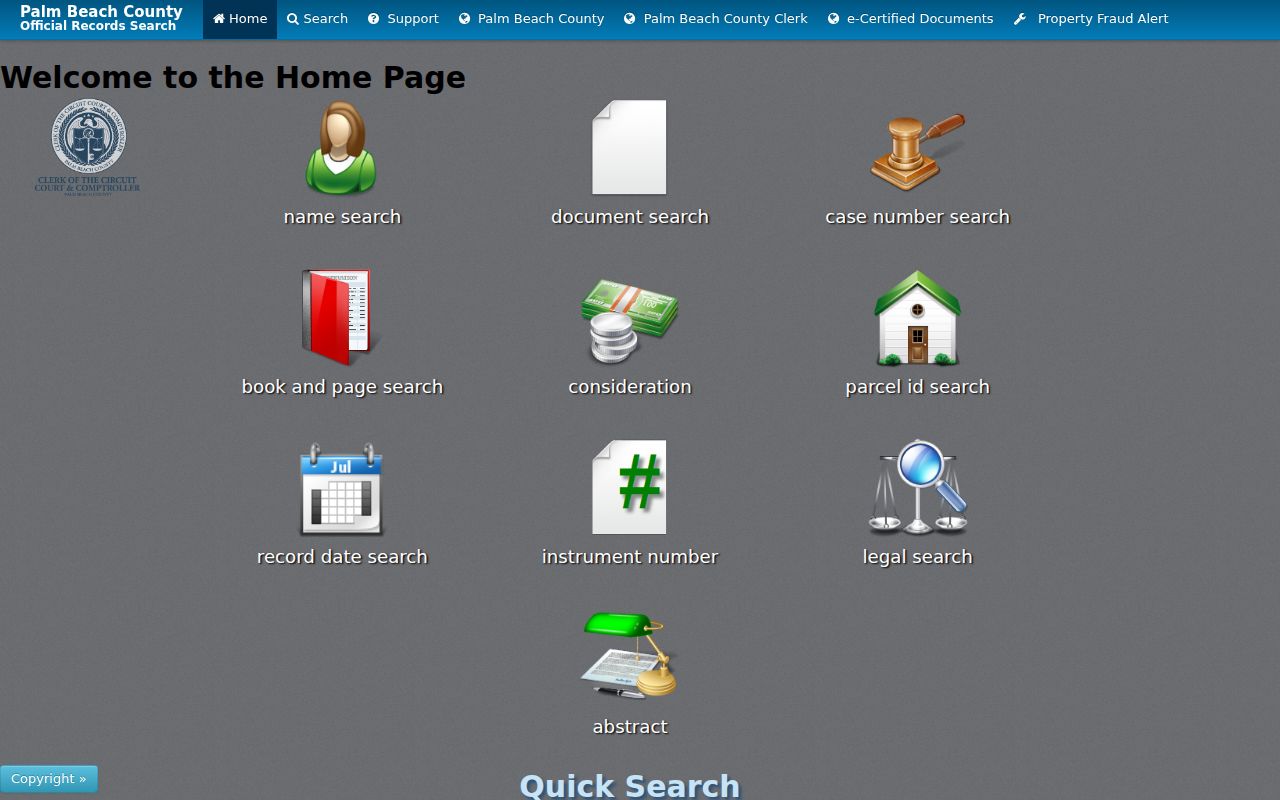
The screen’s multiple search modes show why an instrument number, book and page, party name, parcel ID, and legal description should all be saved. Any one route may succeed when another returns nothing.
A deed result may show party names and roles, Clerk File Number, Official Record book and page, page count, document type, record time, legal description, consideration, and an image link. Check both the index and the page image. The index is a finding aid, while the recorded page carries the actual language.
Continue West Palm Beach History Before 1968
Online deed images begin January 1, 1968, but Palm Beach County records do not begin there. Marriage listings reach 1909, and plats and right-of-way maps extend to the late 1800s. An older deed or missing image may be read on microfilm in Room 4.2500 of the Main Courthouse. The Records Service Center also supports phone, mail, and in-person requests.
Mail orders need identifying details, payment, and a self-addressed stamped envelope sent to P.O. Box 4526, West Palm Beach, FL 33402-4526. The direct records number is 561-355-2932. Search service costs $2 per year per name or legal description. Copies cost $1 per page; certification adds $2 per instrument and a $1 authentication cover when needed. An electronic certified document costs $8, plus the stated payment processing fee.
Palm Beach County was created from Dade County in 1909. Pre-1909 land references may therefore be cataloged under Dade. That historical shift explains an old label better than an invented story about lost records. No verified catastrophic courthouse fire or wholesale deed loss was found.
Note: Online image coverage and the underlying record series have different start dates.
Match West Palm Beach Past Households
Deeds establish owners, not every person who lived at an address. To identify previous residents at the household level, pair city-directory checkpoints with released census schedules. Mandel’s microfilm covers 1915–1935, while documented Polk checks include 1916, 1920, 1925, 1930–31, 1935, 1940, 1944, 1950, 1955, 1960, 1965, 1970, 1975, and 1980–81. Current shelf status for sampled volumes should be confirmed.
- Find the address in a directory street section and copy each listed adult or firm exactly, including initials and householder marks.
- Check those names in the alphabetical section for spouse, occupation, employer, widow notation, or a cross-reference.
- Pair the 1915–1935 checkpoints with the 1920 and 1930 census households. Use the 1940 and 1950 schedules for later listed names.
- Compare ages, relationships, birthplace, occupation, and address. These fields can separate same-name people and show relatives who were not printed in the directory.
- Carry the sequence forward with the 1958–1960 telephone scan and investigate the 1989–1995 criss-cross holdings for address-first access.
Federal population schedules open after 72 years. In 2026, the 1950 census is the newest public decennial schedule, with 1960 due in 2032. A disappearance from a city directory does not prove a move or death. Check the next volume, newspaper, probate file, and deed trail.
The collections themselves, their keys, and access methods are covered in the West Palm Beach city directory.
Bridge Changed West Palm Beach Addresses
Postal city, ZIP, street spelling, jurisdiction, number, and occupant may all change while the land stays put. Use the PCN and legal description as the persistent identity. A recorded plat translates subdivision, lot, and block into mapped streets. PAPA GIS then connects that recorded land to the present parcel.
The Library of Congress Sanborn volume covers 1924 and was republished in 1952. Its 72 sheets show building footprints, uses, materials, outbuildings, and street names, not residents. Compare its structure to the printed address in a directory. One catalog quirk matters: LOC labels the item “West Palm Beach, Dade County,” so the county name should not cause an automatic rejection.
A 1907 map, Sanborn sheets, recorded plats, address sections, and current GIS form a century-long map chain. No official citywide renumbering year was verified. Any claimed change should be proved with a dated map, directory, plat, ordinance, or permit rather than guessed.
Date Changes at West Palm Beach Homes
The city’s Citizen Connect access route searches plans, permits, inspections, and code cases by address. It can download available results and create notices for new matching activity. The research did not establish a complete historical cutoff, so a focused city records request remains the fallback for an older or absent file.
Permits date additions, repairs, demolition, or other physical change. They may name an applicant, contractor, or owner, but those roles do not prove residence. Code files likewise document a case, violation, or complainant under applicable public-record rules. Keep these names as supporting facts until a directory, census, deed, or other source connects the person to the household.
West Palm Beach grew from the early downtown grid near the railroad and lagoon into western areas. Older central sites may appear in Sanborn and early directories. Later subdivisions may first appear through plats, aerials, tax rolls, and permits. This development sequence helps choose the record most likely to exist.
Close West Palm Beach Resident Trails
The Palm Beach Post microfilm at Mandel spans 1916–2016. Obituaries, wedding items, social notes, property reports, and business notices can explain why a name appears or disappears. An obituary may connect a former resident to a spouse, children, siblings, cemetery, or funeral home, but it remains a published account. Verify key dates and relationships through certificates, probate, or cemetery-office records.
A probate docket may identify a decedent, personal representative, estate events, public notices, and deeds distributing property. Some documents or addresses can be confidential or redacted. Search the Clerk’s court route, then use the courthouse for records not remotely available. A deed issued by an estate can reconnect probate to the parcel chain.
The Historical Society of Palm Beach County at the restored 1916 courthouse holds photographs, maps, newspapers, architectural drawings, and research files. An address or architecture file may help explain the building between recorded transfers. Mandel’s archive-question service and county genealogy resources add staff and database access when no single branded house-history collection exists.
Use West Palm Beach Previous Residents Carefully
Previous residents are not the same as prior owners. A deed can omit renters and relatives. A directory can omit unlisted adults or use initials. A phone book reflects subscribers. A census captures a household on one date. Permit and probate names describe roles in those files. Label each finding and date it.
Commercial compilations can mix people who share a name and carry old addresses forward. They are leads, not proof. Two independent anchors, such as a legal description plus a deed date or a spouse plus a census address, make a stronger match. A protected address or lawful gap should remain hidden.
A careful chain can answer who owned the land, who was listed there, and how the structure changed without pretending that any source names every person who lived there before.